The ancient civilization of Greece is among the most fascinating civilisations of the history of mankind. Many people are influenced by Ancient Greece and think of magnificent temples, great philosophers as well as the initial Olympic Games. The daily lives of everyday Greeks wasn’t any less fascinating. In the past, Greek society had distinctive customs and practices with regard to the food they ate and the clothing they donned and how they performed their jobs in their leisure, studied and engaged themselves.
Some of the things we take for granted nowadays, such as sports events democratic debates, public meetings and sports originate from Ancient Greece. In fact, many aspects of Greek lifestyles would appear odd to us today also. In the past, Greece Amazing details about the way people lived many thousands of years in the past
Ancient Greece Consisted of Independent City-States
A surprising aspect is that Ancient Greece wasn’t a single nation. Instead, it was comprised by a variety cities-states that were independent that each had its distinct laws, governments and customs.
Famous Greek City States
The most well-known city states included:
- Athens
- Sparta
- Corinth
- Thebes
Every city-state was the size of a nation. Athens was the home of democracy and learning, Sparta was known for its strength and discipline.
Greek Houses Were Mostly Simple
A majority of common Greeks were confined to modest houses . These impressive temples and other public structures that still stand aren’t their residences .
What Did Greek Homes Look Like?
Greek homes are typically constructed from:
- Mud brick
- Stone
- Wood
The majority of houses featured an open courtyard in which families could gather for dinner along with conversation, and other daily events. Families with wealth lived in huge homes, while the poor resided in humble houses.
Olives, bread and olive oil became an everyday staple
Ancient Greek foods were simple however it was healthy. Its reliance on local food items was a major factor.
Typical Foods in Ancient Greece
It was costly and generally consumed on specific occasion or on religious holidays.
Education of Children Was Different
The time of Ancient Greece Education was important particularly in Athens.
Boys’ Education
Boys were taught:
- Reading
- Writing
- Arithmetic
- Music
- Gymnastics
The Greeks believed in the development of the body and mind together.
Education of Girls
Girls generally learned in the their homes. They were taught weaving, cooking domestic management, and the care of children. The girls of Sparta had more training in physical fitness than women in other Greek cities-states.
Sports Were Important Part of the Life
It is believed that the Ancient Greeks loved sports and the physical curriculum.
The Olympic Games’ Beginnings
The very first Olympic Games took place in 776 BCE. Athenians competed in these races:
- Running
- Wrestling
- Boxing
- Long Jump
- Javelin Throw
- Chariot Racing
The city-state and the individual athlete was able to claim a great honor in being the winners of the Olympic competition.
Religion Affected Everyday Life
Religion was a major aspect of early Greek society.
Popular Greek Gods and Goddesses
Greeks were a god-shy people like:
- Zeus
- Athene
- Apollo
- Poseidon
- Artemis
They believed that gods were in charge over luck, nature or success as well as personal events. Festivals and religious ceremonies were held all through the season.
The Agora Was the Center of Social Life
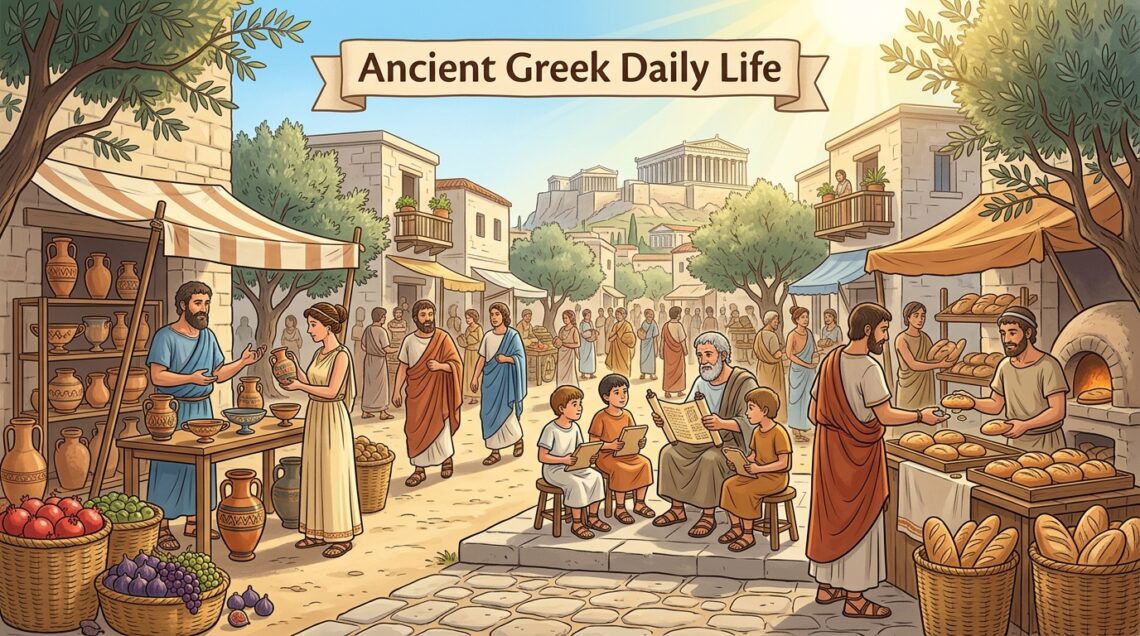
Each Greek city was a marketplace, referred to as the Agora.
The reason was it that the Agora was significant?
The Agora was beyond a mere shopping center. The people who visited it were:
- Purchase food items.
- Make money selling the product
- Gathering with Friends
- Politik diskutieren
- Watch speeches by members of members of the public
It was at the heart of life in the community.
The Greeks were awed by entertainment.
In the past, even thousands of years ago the people were having fun.
Popular Entertainment Forms
The Greeks loved:
- Storytelling
- Festivals
- Dance
- Music
- Theatre
The theatre was very popular. Nowadays, a lot of Greek shows are still staged throughout the world.
Women’s roles varied between cities.
The life of a woman was dependent on the place she resided.
Women in Athens.
Women in Athens in general:
- Households are managed
- Children, rearing
- Ready-made food
- Staff members who are supervising
They were then excluded from the public sphere and politics.
Women of Sparta
The Spartan women enjoyed greater freedom. They could:
- Own real estate
- Do some exercise
- Handle Family Finances
- Engage in community-based activities
This is what made Sparta quite unique among antiquated societies.
Philosophy Was Daily Life
The early Greeks loved to discuss big questions concerning life and the universe.
Famous Greek Philosophers
The most well-known philosophers are:
- Socrates
- Plato
- Aristotle
Their theories have been influential in contemporary sciences, education and ethics as well as politics.
Baths were a popular meeting locations.
The Greeks frequented the public baths often.
What Did People Do in Public Baths?
The public bathing facility could be used for:
- “Clean themselves”
- Chill out
- Meet friends.
- Discuss current events
They played a crucial role as social hubs within a variety of Greek groups.
People Walked Almost Everywhere
In the absence of modern transportation The main method for getting around was walking.
Ancient Greece’s Daily Travel
A majority of people went towards:
- Markets
- Temples
- Schools
- Workplaces
Greece is home to many coastlines and islands which is why people frequently traveled for long distances on boats.
Slavery Was Commonplace in Ancient Greece
The practice of slavery was also common within Greek society. This was is one of its dark sides.
People who were enslaved were forced to work
- Houses
- Farms
- Workshops
- Mines
A large portion of the economy was dependent upon their labor. In the past, Greece was a major contributor to civilization, however slavery remained a significant aspect of the modern world.
The daily life of the early Greeks
Here are a few quick information that may surprise lots of individuals:
- Greeks utilized to submerge the wine prior to drinking the wine.
- Fitness is a sign of character.
- People debated politics a lot.
- The festival can last for many days.
- The majority of furniture was functional and straightforward.
- The education system is designed to develop the intellectual and physical abilities.
Conclusion
The day-to-day activities that was typical of Ancient Greece was built on practices, traditions and customs that continue to influence our modern world. People from many thousands of years ago had ideas of sports, education political and social interaction that remain relevant to us today. In the past, Greece was an active and progressive civilisation. From lively marketplaces as well as Olympic games, to philosophical discussions and festivals of religion.
Understanding the daily life of everyday Greeks can help us understand the ways in which this extraordinary society operated without regard to its celebrated landmarks and historic individuals. As we dig deeper into Ancient Greek history, the more we learn the ways in which its influence is still influencing our society even today.